Latest notes

AI: The Writer's Archaeologist

I may lack the charming grin, wide-brimmed fedora, and trusty bullwhip of Indiana Jones.

But I definitely felt like an archaeological adventurer this week.

I recently used Codex to rebuild my personal website. As Codex was building, it pulled in old posts from my Squarespace archive from a file on my Mac, unprompted.

That got me thinking: where else could Codex look for my old posts? After all, I’ve been blogging off and on since at least 2004. There has to be old stuff out there scattered amongst the ruins of the Internet.

Turns out there was. A lot of it.

The Expedition

Finding two decades’ worth of old posts would be a tedious nightmare—I’d simply never do it. Let alone taking on all the formatting drudgery involved to get those posts onto my new site.

But Codex couldn’t wait to get started. And it had a plan.

Yes. I can search old author profiles, backlinks, archived blogrolls, redirects, domain-registration traces, and distinctive phrases from your known posts to uncover domains you no longer remember.

It immediately surfaced 11 pieces I wrote on Medium from 2014–2015. I have no recollection of posting on Medium. But I recognize the work. It also found two guest articles I wrote for Real Estate Magazine.

Then Codex informed me I had a blog on Blogspot. News to me.

Next, Codex unearthed an old site of mine called AskTheCopywriter.com. But how did Codex know it was mine?

Your own archived copy describes it as the place to visit for your marketing tips, copywriting insight, and “occasional drivel,” so this is strong first-party evidence that it was yours.

Um, ok. A little insulting, maybe, but accurate.

Then, Codex asked:

May I check Portugal’s public web archive for copies of the forgotten Blogspot and Ask the Copywriter sites that the Wayback Machine may not have preserved?

Suddenly I was nervous.

Portugal is keeping files on me. Why? What kind of files? I’ve never even visited Portugal. But Portugal, it turned out, contained riches:

This turned into the biggest find so far. The original Typepad hostname behind matttillotson.com now exposes archived post URLs that the earlier custom-domain sweep could not see … and appears to contain dozens of additional posts.

Codex continued:

May I retrieve the two archived FeedBurner feeds to recover any titles and dates absent from the page archives?

FeedBurner? Be still, my blogging heart. We had fun tech in those days.

The Recovery

In all, Codex found 81 posts that weren’t part of my new site, dating back to 2004:

  • 46 posts from Typepad
  • 18 from Posterous
  • 6 from AskTheCopywriter.com
  • 9 from Medium
  • 2 from RISMedia / Real Estate Magazine

With the artifacts uncovered, it was time to move them to the museum. Codex built backdated post pages in Obsidian for each entry and shared this frustration with me:

The old Ask the Copywriter pages need a little extra character cleanup because they predate modern web encoding.

Yeah, thanks. I already knew I was blogging in the days of stone tablets. Didn’t really need the backhanded reminder.

The Reward

Is there value to finding and collecting my old writing?

Sure. First, it’s fun to find this stuff. Especially the surprises.

I love having all my writing in one place, my place, online. More than 20 years’ worth of words!

The way I see my writing has changed. I think back and wish I’d been more consistent in the early blogging days. But man, I sure did try a lot of new things. That’s worth being proud of.

As Codex explored and formatted, a memory was sparked: I did some sports blogging at a site called Palmball.com in 2005. I asked Codex to search for any posts worth saving1.

In one entry, I wrote about Leigh Montville’s excellent biography of Ted Williams. In particular, I was envious of Williams’ singular focus in life:

And it wasn’t that Williams lived to play baseball. It was that he lived to hit a baseball. No matter what went on around him … Williams knew that the center of his existence on earth was to hit a baseball.

My inner critic considered my writing scattered, intermittent, and unfocused. It left me wondering what might have been if I’d had more clarity and consistency.

But this project showed me I was never meant to write about one thing. My writing is about exploring interests and finding ways to connect ideas across them.

One of AI’s best gifts for writers is helping us see our body of work in a new light.

I learned my writing is a little like Ted Williams after all.

I’ve taken a lot of swings. And I’m not done yet.

Footnotes

  1. Another nine posts, making it an even 90 posts that were rescued and restored.

Enough Doomerism

AI is the greatest tool ever built for writers. 

While everyone freaks out about AI destroying human creativity, you can use AI to:

  • Help you pull out and develop hidden ideas in your writing
  • Organize and mine your reading to support and develop your writing ideas
  • Build a personal website to create a permanent home for your work
  • Edit and tighten up your work (without having AI rewrite it)
  • Help you see new ways to connect your previous ideas

And so much more. 

I am so excited about the future of writing, bolstered by what AI can help do to enrich and support our work. 

ChatGPT really started to take off a few years ago while I was at Write of Passage. At that time, it was hard not to feel that AI would eventually destroy human writing, and that was disheartening.

I feel 100% differently today. 

Writers who embrace AI have a bright future.

The New Personal Website Stack

I have seen the blog wars, and written in their muddy trenches.

I learned some HTML. I built in Microsoft FrontPage, and later used Blogspot, Typepad, Posterous, and Squarespace. You get the idea.

Things have changed fast. Now you can build and maintain the exact website you want, quickly and far cheaper than ever. Without technical knowledge.

Personal websites are back, and so is mine.1

Using Michael Dean’s post as a template, I wrote up goals for my site, loaded it all into Codex (OpenAI’s coding agent), and told it to create a site plan. I wanted a simple site (modeled somewhat after the timeless Daring Fireball) so I could focus on writing.

With that in place, I turned Codex loose.

The tech stack

Obsidian

The note-taking app Obsidian is home to all my content, as opposed to a complex content management system. Book reviews, my Kindle highlights, and new posts all live as simple Markdown files in Obsidian. No database needed—just text files on my Mac.

If you’ve never used Obsidian2 or worked with Markdown, don’t fret. Both are simple enough to get started with. And if you’re confused by either, ask AI. It will explain whatever you need to know.

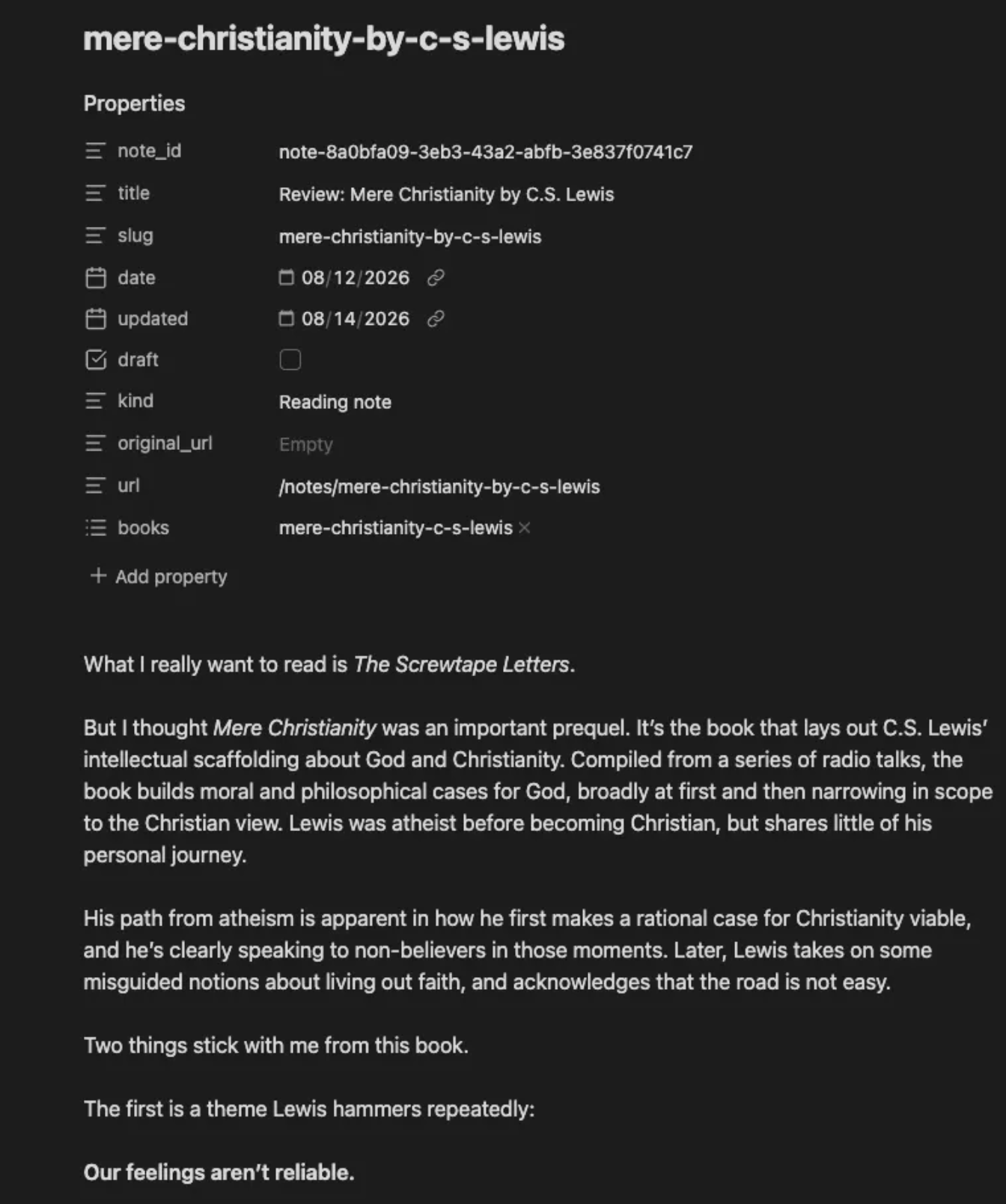
Here’s what a post looks like in Markdown: Pasted image 20260814155330

The properties at the top tell the website what to do with the post. There’s also a draft checkmark. When I remove the check and press the publish button, the note is uploaded to the next step.

GitHub

GitHub is where a complete history of the website is stored, and where automated sanity checks take place (reviewing metadata, links, images, and more to make sure everything works). Codex built the set of review rules. If all the lights for a new post turn green, then it is on to the next step. If something is off, Codex diagnoses the problem.

Cloudflare

Cloudflare hosts and serves the website from my custom domain. Because my site is small and simple, I pay Cloudflare nothing today. If tons of you visit, I might have to pay $5 a month, eventually. In contrast, Squarespace (which, to be fair, handles every step of site building and hosting) is around $400 a year now.

Think of the infrastructure like this:

  • Codex: The contractor who built and maintains the site.

  • Obsidian: The workshop where content is written and organized.

  • GitHub: The storage and quality control facility where file versions are kept and inspected.

  • Cloudflare: The storefront where the finished site is presented to visitors.

As a reminder:

I cannot code. I have a rudimentary understanding of what’s going on, but Codex built the infrastructure and process for me. I made decisions around site design and structure. Codex did all the dirty work, and makes additional site changes at my discretion.

I have some knowledge of how websites should be organized, and what I wanted mine to look like. All I had to do was describe it.

Surprises

Codex had a few “ta-da” moments during the build.

First, I referenced my prior Squarespace website in my design brief. On its own, Codex found my downloaded Squarespace site content archive on my Mac,3 and pulled in and formatted all my old posts in Obsidian, so they were part of my new site.4

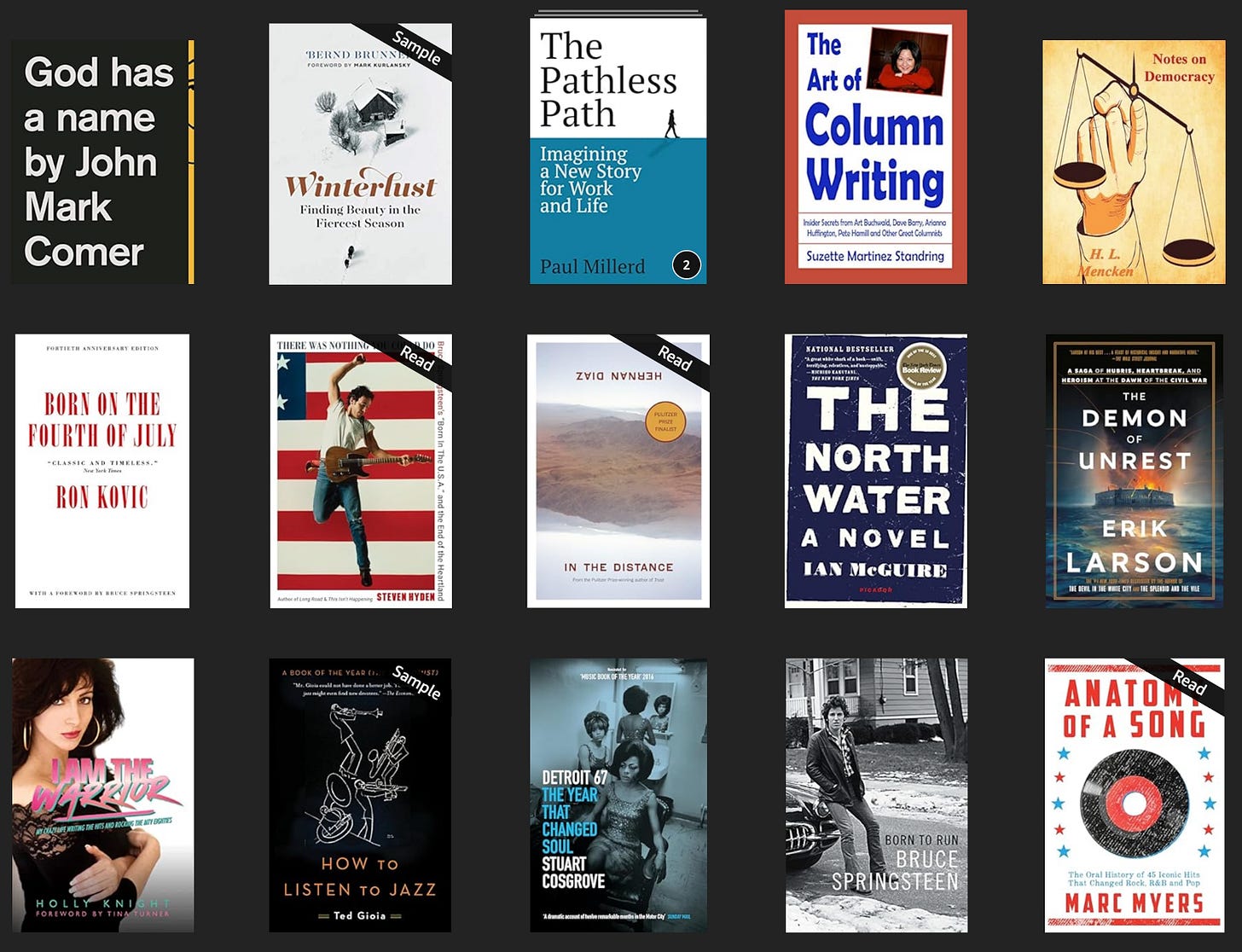
Codex also found, without me asking, the 26,464 Kindle highlights I had stored in a CSV file from this project. It built unique pages for each book and attached all the Kindle highlights to each book’s page.

Codex also built custom buttons in Obsidian:

  • Publish a note (blog post)

  • Add a new book web page

  • Add a one-off web page

  • Download new Kindle highlights

  • Tag a book in a note

I’m not writing commands or running between applications. I tap buttons in Obsidian. The infrastructure may be complex, but my workflow is not.

Site structure

  • Start Here: A little about me, my work, and the website

  • Archive: All my posts

  • Books: A searchable list of over 450 books I’ve read in Kindle, with links to a book page for each. Each book page contains any posts I’ve written which reference the book, and the Kindle highlights for that book from my library.

  • Newsletter: A signup page for my Substack.

Over time, I’ll add some additional sections, but will fight complexity. Site-fiddling is a great way to avoid writing, while telling yourself you’re being useful.5

AI has made bespoke, personal websites available to people who want to focus on creating, not coding. It handles the technical backend so we focus on our craft.

Bring on the personal website revolution.

Footnotes

  1. You can read why I relaunched my site here. In this post, I focus on the how.

  2. I hadn’t before this project, but had used Roam Research, which seems similar.

  3. Yikes? I mean, kinda cool, but also, yikes.

  4. This sparked an idea for another project for the site, which I will cover in a future post. It was a fun project.

  5. I saw writers use this delay tactic dozens of times at Write of Passage, and am a repeat offender myself.

Review: Mere Christianity by C.S. Lewis

What I really want to read is The Screwtape Letters

But I thought Mere Christianity was an important prequel. It’s the book that lays out C.S. Lewis’ intellectual scaffolding about God and Christianity. Compiled from a series of radio talks, the book builds moral and philosophical cases for God, broadly at first and then narrowing in scope to the Christian view. Lewis was atheist before becoming Christian, but shares little of his personal journey.  

His path from atheism is apparent in how he first makes a rational case for Christianity viable, and he’s clearly speaking to non-believers in those moments. Later, Lewis takes on some misguided notions about living out faith, and acknowledges that the road is not easy. 

Two things stick with me from this book. 

The first is a theme Lewis hammers repeatedly: 

Our feelings aren’t reliable. 

We can’t base our faith on feelings alone. They come and go, and can betray you. Yes, we can feel love for and from God, but at times those feelings will be tested and frayed. We need an understanding of what we believe and what God asks of us—rigor we can lean on in times of questioning and doubt. Feelings matter, yes, but not as much as our own will and action.

Second, and the single most important takeaway for me, is this question Lewis poses:

“If you knew you loved God, what would you do?”

This question can never fail us, though we will fail the question. 

We will know the answer and still not do that thing, because we are human. But simply asking this question in any challenging situation increases the odds of taking right actions. It’s also a clear and simple framework for reflecting where we’ve gone wrong. 

Mere Christianity is valuable intellectual underpinning for many of Lewis’ other books. That’s what I went looking for. Surprisingly, I also came away with a practical and simple framework for my own actions: asking the right question, and leaning on conviction over emotion to make choices that are sometimes hard.

Maybe We Should Become Our Parents

I used to find the “Homeowners Turning Into Their Parents” Progressive ads funny. The other day, the “Waiting Room” commercial was on, and suddenly my perspective on the ads flipped on its head. 

What if the “patients” in these ads are just being earnest and trying to make small connections with people in their community?

What if our culture is so insular and cynical and broken that we see simple attempts to help and friendliness towards strangers as dumb and outdated?

These commercials are sharp and brilliant cultural commentary disguised as humor.

I liked it better when I just thought they were funny insurance commercials.

The Case for a Personal Website in 2026

My daughter is hooked on this coffee place called Seven Brew. 

I believe the establishment is so named because seven is the minimum amount of ingredients and flavors you must add to your drink order.1 Often, I have learned, a Seven Brew drink doesn’t even contain coffee. I think that’s because there isn’t room left in the cup after all the other stuff is added.

The most popular drink combos shift all the time, powered by TikTok trends.

A personal website that hosts your writing is the black coffee of the internet. Timeless. Useful. Never goes out of style, even as trends whirl and shift around it.

I didn’t always believe this. 

In 2024, it seemed personal websites had run their course. Substack seemed a haven for writers. I went all in, shutting down my standalone site.

My blog-building began with Microsoft Front Page in the early aughts, before moving to Typepad2 and then Squarespace.

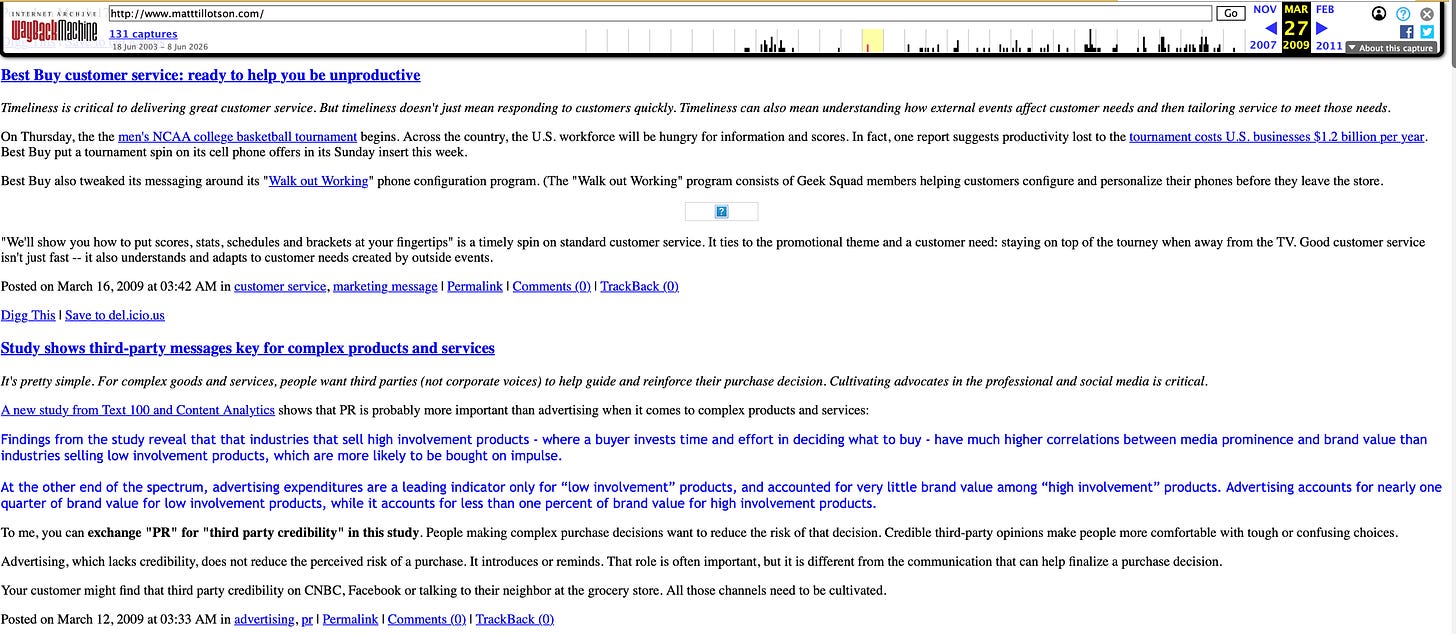
Here are a couple of posts from 2009,3 just to keep things honest:

Pulling the plug on my own website was a mistake.

I owe much to Michael Dean, who relaunched his own personal site, and wrote this post about how he did it. That nudged me to rebuild my own.4

The Free Traffic Engine Sputters

I don’t want to discourage anyone, but if you launch a personal site to build attention and visitor traffic, you’re facing Cat 5 headwinds.

One study suggests that as of early 2026, 68% of Google searches end without a click to a link, with users opting to read Google’s AI-generated content instead.5

The second challenge is AI chatbots. As more people turn to AI for answers, only 5.2% of information-seeking sessions result in a click

Traffic to the open internet is drying up.6

Now that you are sufficiently disheartened, let me pivot: there are good reasons to have a personal website.

Why bother with a personal website in 2026?

My reasons will be different than yours. As it says in the top left column of my site: 

A site to ingrain and invigorate the habits of reading and writing.

A couple of things are true for me: 

  1. When I exercise every day, I feel better and work better.

  2. When I read from a book and write every day, I think more deeply and am more creative.

I’m on top of the first practice. The second had become inconsistent. My creative energy isn’t served by sporadic effort. It requires swinging the hammer daily.

And my site serves as the fulcrum for that daily rhythm. It’s a catalog of the books I read, the passages I highlight, and the writing that comes from that consistent reading habit. 

One page lists most of the books I’ve read in Kindle since 2010—around 450 or so. All the book passages I’ve highlighted—more than 26,000 of them—have been sorted and imported onto a page for each book.7 Any reviews or related entries I’ve written about a book also appear on that corresponding page. My new writing is shared and archived, blog style, on the front page. The site also has a bunch of my archived posts from my old Squarespace site. 

It’s fun to integrate some of those Kindle highlights into my writing. Those 26,000 passages represent the words that stuck with or surprised me over 15 years of reading. 

The site leans into my personal thinking trail and my perspective. The stuff that, you know, makes me a person and not software.

Anything I write now goes on my personal site first. That includes longer essays, like this one, and shorter notes. Some of that writing will also be shared and distributed here. But my site is the central repository for all my writing. 

So, to sum it up. My personal website:

  1. Serves as a living catalog of the books I read, the passages I highlight, and my own ideas and writing.8It helps crystallize my own perspective.

  2. Serves as an accountability engine to sustain my habits of reading and writing. 

Could I just post everything to social media? Of course. But think of it like this:

There is value to sharing your writing on social sites. I’m not arguing you shouldn’t. But the amorphous social media landscape never holds still. Look how often the X algorithm changes.9 Facebook might become another TikTok. The energy is always on the move. 

With your work anchored on your own site, you’re can follow that energy to other channels.

Social media is gambling on a football game. The value is here and gone. A personal website is investing in an index fund for 20 years. Value compounds.

An Antidote to AI Doomerism

We are subjected to an endless tsunami of negative content around AI: that it’s replacing our creativity, destroying our ability to concentrate, and obliterating our ability to express ourselves. 

This project does the opposite. AI did all the coding and formatting dirty work so I can read and write. I feel the rust coming off, because I don’t have to worry about the technical machinery. 

In 2026, a personal website isn’t primarily about amassing traffic. It’s about what you want to make, organize, and preserve that would otherwise be lost.

My site is the black coffee that jolts me into reading and writing every day. I’ll drink to that.

Footnotes

  1. What is cold foam? Is there hot foam?

  2. Typepad shut down in August of 2025. What a run. 

  3. I didn’t say they were good posts.

  4. Another day, I’ll share a post about the base technologies, the build, and the ongoing process of publishing my site. Today is just about the why. 

  5. Nilay Patel calls this “Google Zero.”

  6. Someone is working on this, right? How about a search engine that indexes sites, and provides links to them based on user queries. Wild idea, I know.

  7. Here’s how I extracted and compiled those highlights

  8. In at least one alternate universe, I work in a library. I’m sure of it.

  9. Hourly.

Geo-Piety On The Bookshelf

Every Michigan bookstore should have a Michigan authors section. Most stores I've been in seem to have one, so I don’t think I need to propose legislation. 

Pasted image 20260809140357

I’m not surprised bookstores1 take this tack, and it’s about more than sales. Michiganders are of two minds: for one, we complain about this place a lot. The roads, the weather, the taxes. But we’re also fiercely parochial: we love the state and the people and things within it and from it. 

There’s a term for the latter, as defined by Jim Harrison in True North:

Each village was obsessed with the history of its own immediate area and infinitely less so than in the history of the village a mere thirty miles away. Later in life I learned that human geographers called this “geo-piety,” which also applies to larger units and fidelities like the Michigan State-University of Michigan football games.

If Michigan is worth celebrating2, then so are its authors. That’s about state pride, yes. But even better, it’s about local voices helping us see a familiar place in new ways.

Footnotes

  1. This photo was taken at Sleepy Dog Books, in Mount Pleasant.

  2. It is.

Don't Fight Your Nature

I am not an elegant writer.

Back when I was young and my skull was still full of unformed mush, I stuffed it with millions of words from Midwestern newspapers. Mitch Albom. Mike Royko. Huge doses of sports sections, daily.

As a consequence, I write in a plain-spoken manner, like I'm sitting across from you at a diner, sipping black coffee that sat too long in the pot. Sometimes I try to write with elegance, like I'm placing poetry on parchment paper.

That always fails.

As comic book legend Brian Michael Bendis said:

Write true. Write honest.

My best writing leans into a folksy, straightforward style. Anything else comes off murky and confusing. If I try to get elegant, or shock you, or make you mad, it never works.

Explore the borders of your writing voice, sure. But don't wander too far into false territory. You and your reader will both get lost.

The iPad Remains Apple’s Ultimate Rorschach Test

This week, I bought a favorite Apple product for the last time. 

I have a soft spot for iPads. Always have, since buying the original in April of 2010 for a quaint $499. I’ve always loved the portability and indefinability. Can it replace my laptop? (For a long time, the answer was no. Now, the answer is yes, but not quite as perfectly as you’d like. And now many models cost more than MacBooks.)

My favorite iPad peripheral (that I just bought again for the last time) is a divisive choice: the Smart Folio Keyboard. Apple discontinued the keyboard several years ago, replacing it with a bulkier, fancier, and of course more expensive, model: the Magic Keyboard for iPad.

People seem to love the new keyboard. But it bloats the iPad, wrapping it in the bulk and weight of a laptop. 

The now-defunct Smart Folio Keyboard does not bloat the iPad. It complements the design, protects the device, and delivers a unique typing experience.

Many people hated the keyboard. Jason Snell, who writes about Apple and tech, compared the typing experience to “typing on a tent” because of its outer fabric shell. 

But I love that keyboard, still.

And my old one wore out. That’s why I bought one, still new and in-box, to partner on a final adventure with my 12.9” 5th-generation iPad Pro. Thanks to a corner crack in the screen and AppleCare, my aging iPad was replaced last fall with a refurb: new battery, new casing, new life. My 2021 model now has plenty of miles to go, and a tentesque keyboard to ride along with it.

Pasted image 20260807152007

The keys strike with a Batman-like “Thwack!” It’s the sound of authority. The sound of justice. The sound of the Dark Knight landing a decisive right-cross to the Joker. 

No other keyboard has the same sound and feel. 

Of course, the 12.9-inch (or 13-inch as Apple refers to it now) iPad Pro is the wrong iPad for just about everyone, including me. It’s a little too large and heavy for true iPad convenience. It’s not a one-hander: you need to hold it firmly at 3 and 9 o’clock to keep it steady. It’s just a little too small to replace an adequate MacBook screen. And it balances like a drunk on a barstool when on your lap.

But I like it for “kitchen table” tasks — easy web browsing, or thwacking out an email or two — while my big MacBook stays upstairs. Also, the bigger screen can cover a second football game nicely, perched on the coffee table, while a main game plays on TV.

I also have an 11” iPad Pro. Because if you’re not sure what to do with one iPad, by all means get a second one.

The use cases are crystallized on my 11-inch device. That’s where my daily habits of reading and writing get done. It’s my primary device for reading books, whether in bed, on a tabletop, or perched in front of my sweating face on the elliptical. It’s also the ideal size for an old comic book nerd who still likes to check on the aforementioned Batman. And, paired with a standalone Apple Keyboard (not the foldable) it’s the perfect size for banging out rough drafts in daily writing sessions. 

An eleven-inch screen is expansive enough for writing, but cramped enough to ward off the temptation to bring in a second app for distraction.

The limitation of the screen is not a bug. It’s a top feature. 

09CE86C6 A232 4EDA 98D1 03D3C5193BB3 1 105 c

Besides artists, I’m not sure anyone needs an iPad. 

If you have a phone and laptop, you have everything covered. The iPad lurks in the hazy no-man’s-land between those two products. It’s pretty good for lots of tasks, and ideal for very few. But that hazy ground is a fun place to stumble around, tripping over new use cases and improvisations. You can reinvent your iPad, over and over. 

My dad still rolls with the iPad he bought in 2013. Never upgraded. Never put in a new battery. Software updates dried up long ago. But it keeps doing what he wants it to do, so why upgrade?

What took me two iPads to figure out, he figured out with one, over a dozen years ago.

The iPad lets each user decide what it’s for. Everyone looks at the same slab of glass and sees a little different device. For me, the iPad supports a daily reading and writing habit. For you, it’s probably something else. The iPad has survived for 16 years not because Apple nailed exactly what it’s for, but because you make that choice.

Unlike me, you shouldn’t need two iPads to figure that out.

How AI Can Turn 26,624 Kindle Highlights Into a Searchable Brain

The End of Reading is Here,” trumpeted The Atlantic headline. 

My immediate thought: “Good. I’m going to read more. And write more about reading more.”

But the headline missed both the true point of the article and the impact of the trend. 

Reading isn’t dead. Instead, it’s retreating from the general population, and growing in concentration amongst ~20% of us, who are reading more:

Last year, print-book sales were higher than they were a decade ago. Barnes & Noble opened more than 60 new stores. Almost 400 independent bookstores sprang up in 2025.

Older Americans, college grads, and women are driving book sales today. 

Some of us will continue to read (and write) a lot, and benefit greatly from it. Most people will enter a post-literary, video-and-audio only age. That doesn’t mean people won’t know how to read at all. They just won’t choose to read. And then reading comprehension, writing quality, the way we think and share information — that all gets worse.

Our literate society was, the theory goes, just a moment in time.

Not only will I read more, but I want to get more out of my reading. I want to share insights and sparks and weird idea connections with others who also want to keep their book brains switched on. 

Part of that is better mining material I’ve already read. 

For example, my Kindle library has 484 books in it today.1 I use the Kindle app on my iPhone, iPad, and Mac regularly. It’s a much better reading experience than a book.2 Easier to read in bed, or while eating, and it’s easier to highlight passages that surprise me.

But the Kindle app is locked down. It’s hard to get all those highlights (over 26,000 of them, in my case) into a searchable or useful format. You either need a physical Kindle device to download them, or a subscription to a service like Readwise.

Otherwise, you can view them book by book in the Kindle app or in a browser. 

Until AI, that is. 

I opened the ChatGPT app on my Mac, and wrote a prompt saying I wanted a searchable database of all my Kindle highlights. 

Codex (ChatGPT’s coding agent) asked me to log into Amazon. Then it opened four browser windows, and divided my books into four groups. Simultaneously, it opened and copied highlights from all my books. 

Manually, that process would’ve taken weeks, if I’d ever had the patience to finish.3

Codex knocked it out in about ten minutes, giving me a CSV file containing each highlight and the book and author it came from. For garnish, it also provided an SQLite database4 and a search tool. 

Cool. Now, what can I do with it? 

The real power isn’t in being able to just search for funny Dave Barry lines, or baseball anecdotes, or some specific text. 

The real power is in asking AI to identify patterns and connections across the highlights, and to quickly find all the relevant passages on a given topic area.

There is a lot to use here both as creative fuel, and to learn more about my own interests and how they intersect. 

Queries can be made to find patterns across all the highlights, for example:

  • Which authors have I highlighted the most?

  • What kinds of ideas seem to resonate with me over and over?

  • Are there conflicting ideas I seem to return to?

  • What kind of life do my highlights collectively point toward?

  • What worldview emerges from these highlights?

  • Write a profile of the person who would have selected these 26,000 passages.

  • What subjects do I claim to care about that barely appear in my highlights?

  • Find highlights that complement my June 2026 journal entries.

Or on a more granular basis:

  • Find all my highlights around this idea: ____.

  • Find the best highlight to answer this question: ____. 

  • I need a writing prompt. Find a surprising highlight I could build an essay around.

I love this. 

It infuses individuality into my writing. These highlights represent what interested and surprised me going back to 2010, and that’s not replicable by AI.

Yes, AI can replace our reading. It can supplant our writing. 

Or, we can use AI as a tool in our reading and writing to make it more useful, impactful, and poignant than ever. 

I asked ChatGPT to find a Kindle Highlight to support the idea of AI as rocket fuel for the value of reading. It selected this, from Erik Larson’s The Demon of Unrest:

The search for these invariably becomes a journey full of unexpected surprises and revelations no matter how much a subject has been studied before—because every writer in every time brings to the field a unique lens through which to view the world, formed by his personal experiences and the character of his era.

AI doesn't have to pave over our unique lens. Instead, we can use AI to sharpen it. 

Footnotes

  1. Honestly, there’s comic books in there also. Call it 450 “books,” then. Comic books have reading value. I will write a pro-comics essay …

  2. I understand this is sacrilege for many. There’s a whole other essay here.

  3. I would not.

  4. Whatever that is.

The 1982 Song That Nailed 2026

5M Fridays | Matt Tillotson

A grounded robin, an X detox, sprint science, Donald Fagen's 1982 warning, and a better question for midlife.


The Map

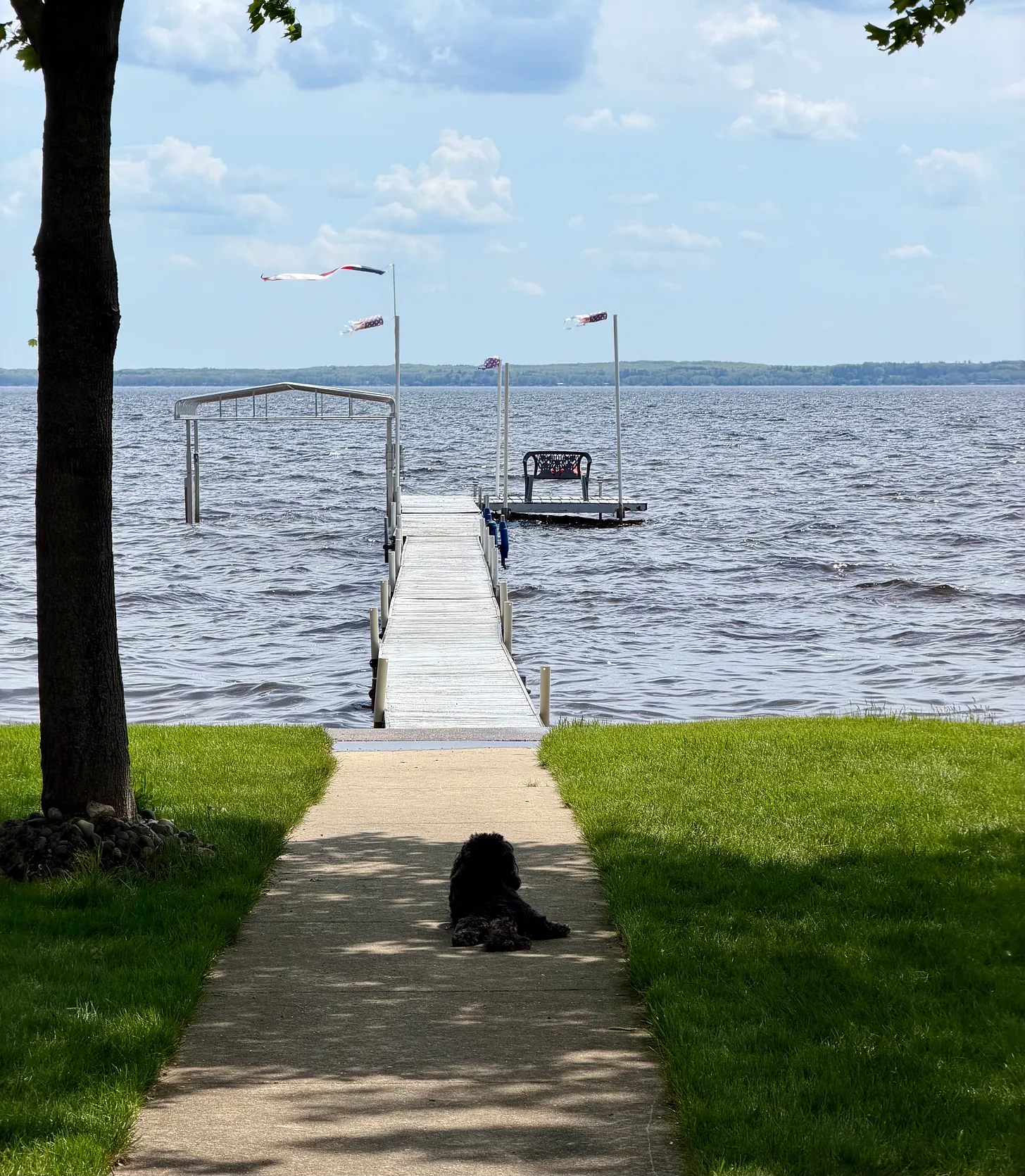
There’s a robin, Michigan’s state bird, hanging out at ground level in our backyard. By the deep coloring it seems to be male. Wings look ok. He’s not particularly afraid of us, though he did flap to the top of the shed when our dog, Lucy, paid a visit.

I can’t tell if his ground stop is by choice or circumstance. He hops around eating worms and getting water drops off garden leaves.

Robins are often the first sign of spring Michiganders seek. But not all robins are migratory. Some hang around all winter, congregating in wooded areas and eating berries instead of bugs and worms.

Maybe he stays at ground level because that’s where the eating is best.

the 1982 song that nailed 2026 011


The Machine

I’m addicted to X.

How can we hear own insights and ideas if we’re incessantly stuffing the ideas2 of others into our brains, one on top of the other, until any voice of our own is buried in an algorithmic avalanche?

Two nights ago, I started an experiment. No social apps, just a book when I went to bed3.

I read books on my iPhone and Mac4. That first night, the urge to stop and scroll X erupted, over and over. I felt disconnected from the world, from its energy, by not reading tweets. It was a powerful sense of loss. Almost mourning.

The next night was easier. And I didn’t feel the need to scroll much during the day, either. Maybe this habit is easier to break than it seems. Maybe I don’t have to spend a month rocking back and forth in a cold sweat. A small change can snowball, and I hope to hear myself again.


The Muscle

This week, I inserted a round of stationary bike sprints (4 rounds, 30-seconds all-out effort, 45 second recovery) in the middle of my 2-hour “zone two5” elliptical session.

Turns out there may be something to that:

Daniel Rowland@dwrowlandIncluding sprints within a prolonged LIT session augmented muscular adaptations related to fat metabolism, angiogenesis, and protein turnover without impairing next-day muscle performance.

onlinelibrary.wiley.comEffects of including sprints during prolonged cycling on hormonal and muscular responses and recovery in elite cyclists5:59 AM · Jun 25, 2026 · 3.68K Views


5 Reposts · 24 LikesIn English, this means the study showed improved fat burning and vascular efficiency without lengthening muscle recovery time.

Of course, this study was with an even longer workout: 4 hours on a stationary bike, with three rounds of 3 x 30 second sprints, using elite-level trained athletes.

But we could expect some improved fat burning, even in a session like mine, which was less intense than used the one in the study.6


The Music

To my knowledge you cannot wear out a digital file. But my copy of this song may disprove that theory.

It’s “I.G.Y.”, by Donald Fagen, from the 1982 album The Nightfly. It’s pure Fagen — jazzy yacht rock, glimmering and celebratory on the surface, but all sarcasm and mockery underneath.

“I.G.Y” is a criticism of blind faith in progress and technology that fits 2026 almost too well.

Embedded media


The Middle

Midlife is a time for re-evaluation. Every time I read or hear a variation on “What are they gonna do? Reinvent themselves at [INSERT MIDDLE AGE HERE], I laugh a little and think, “They better.”

I had to do it at 48. Might be doing it again at 52. And I suspect there will be many more reinventions to come. I hope so.

In Depth Over Noise,Karun Pal writes about living a slower, deeper, more intentional life. In it, he shares a question that’s better for driving reinvention than asking, “What is my life’s purpose”:

When you ask “ What is the purpose of my life,“ you will look for an answer in the outside world.

[…]

When you ask yourself “How do I want to live my life,” it aligns you with your inner truth. It shows you your needs.

Social media shoves you toward the first question and feeds you infinite answers, none of which are genuine to you. And that obscures your ability to get real answers—your answers—to question two.


Archived from Matt's newsletter.

Footnotes

  1. Photo credit: my wife. Who also found the bird to begin with.

  2. Ideas is charitable. Propaganda, clickbait, ragebait, AI slop. If only it were just ideas.

  3. Theo of Golden. Pretty good, so far. And I read some comics. They unwind my mind.

  4. I love the idea of physical books. And bookstores. But I read digitally. It’s so much more convenient.

  5. Fitness speak for, “Not going that hard.”

  6. Consult your doctor, I’m just a bald guy at Planet Fitness, etc.

The 76-Year-Old at My Planet Fitness

the 76 year old at my planet fitness 01

The case for staying put, Siri's real edge, Rick Springfield at Planet Fitness, lifting before it's too late, and peak '80s album-cover testosterone.

The Map

Where are all the “stay put” missives?

So much Internet content celebrates being on the move: photographed restaurant meals and hidden-beach Reels. Or celebrating people moving to a new city.

Travel, in all its forms, is deified.1

Maybe it’s my season of life, but I don’t care about going anywhere. Back home after 25 years, I realize there’s more here than I could ever discover. And certainly a ton I never appreciated.

This is a wide-open content lane being ignored. Being grateful, learning, discovering, exploring, contributing right where you are.

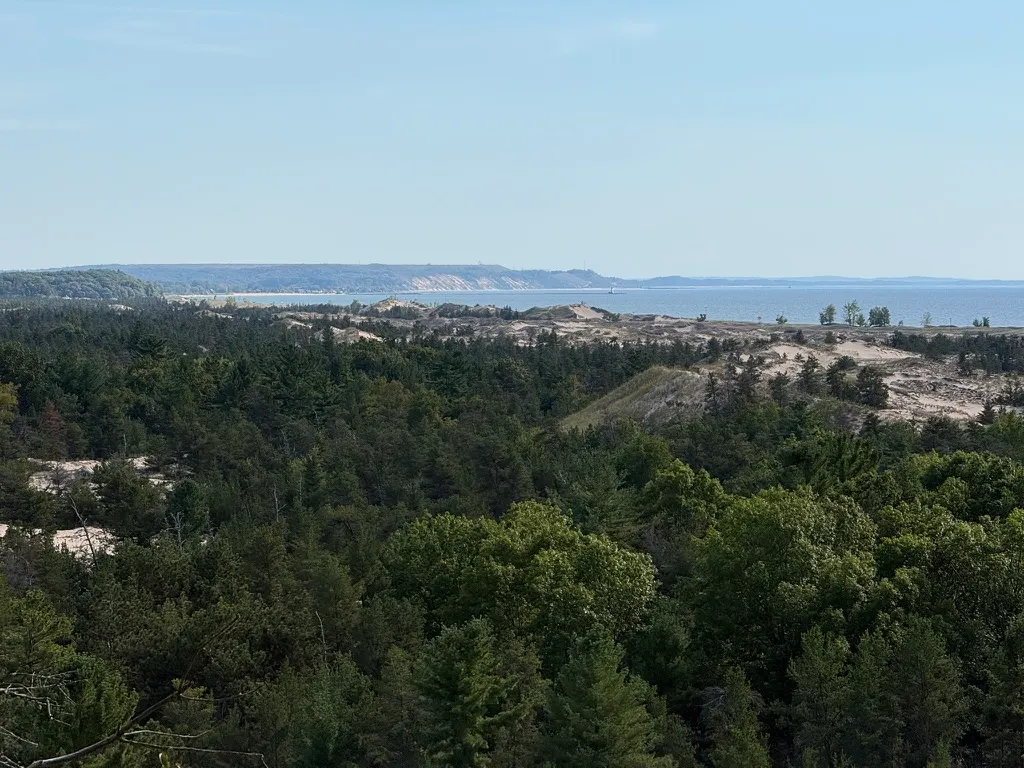
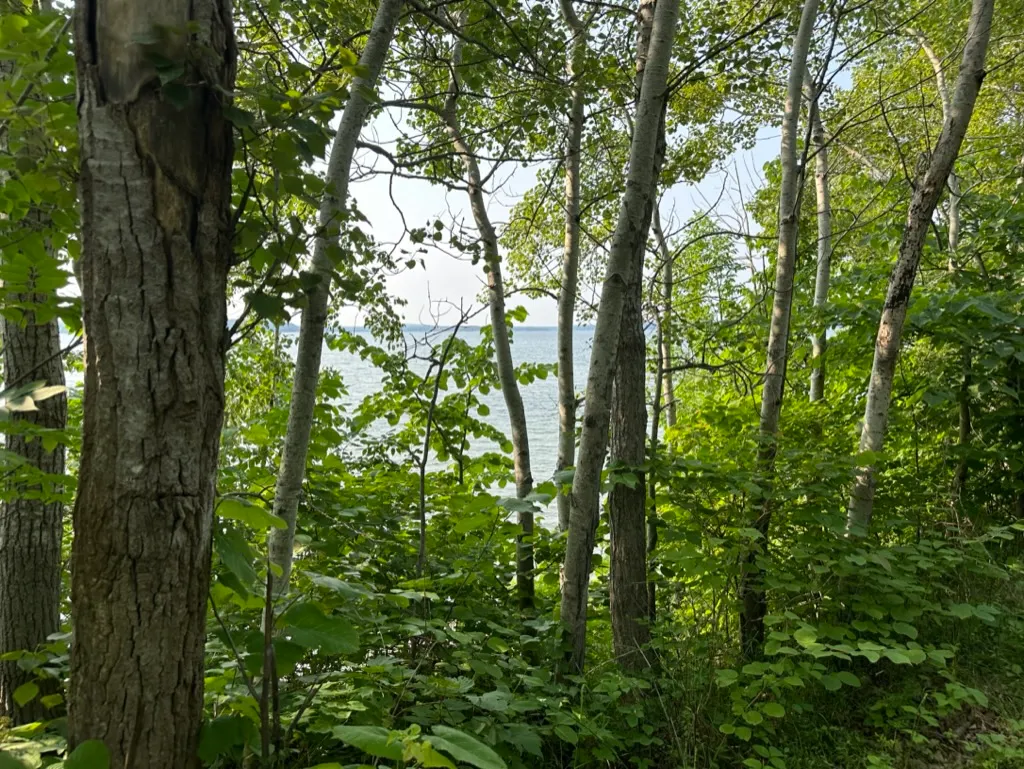
Meanwhile, here’s the view from Ludington State Park’s Skyline Trail Loop, just 92 miles from where I’m tapping out this stay-put idea.

the 76 year old at my planet fitness 02


The Machine

Last week, Apple unveiled the new Siri AI at its Worldwide Developer Conference. Siri has been a crushing disappointment for years, and the last two were the worst, when announced AI features never shipped.

It seems that will change when iOS 27 rolls out in September.

The advantage Siri will have over ChatGPT and Claude? It’s not bleeding-edge intelligence. Other LLMs seem far ahead, for now.

Siri’s advantage will be twofold: convenience and context.

All those iPhones, Macs, and Apple Watches will have Siri available with a single tap. Zero-friction access.

Secondly, Siri will have (if you allow it) secure access to your messages, photos, emails, location — all the personal data on your phone.

That might make your skin crawl. If not, it can be very useful, as Joanna Stern shows in her Siri AI test drive:

Embedded media


The Muscle

I don’t understand Planet Fitness hate.

I’ve worked out there for almost a year now, after several years at Crunch locations. Yes, the heavy end of their free weights are lacking. But it has everything most people need.

That includes Rick Springfield.

In town on his tour with Sammy Hagar, Springfield showed up to work out at my local Planet Fitness this week. He was adorned in sunglasses and a T-shirt bearing his name, just in case there were any lingering doubts as to his identity.

Springfield is 76 years old.

the 76 year old at my planet fitness 03

"I work out every day,"

[..]

Basically, I watch what I eat, and I try and stay active."

He flies around the stage like Mick Jagger. If this is what Planet Fitness gets you at 76, I’m in.


The Music

Speaking of Springfield, dodged raindrops to see his show with Sammy Hagar this week. Hagar has a bit of an all-star band going these days: Van Halen bassist Michael Anthony, former John Mellencamp drummer Kenny Aronoff, and guitar legend Joe Satriani.2

Sammy’s vocal range is a bit diminished, but he’s as charismatic and energetic as ever. Someone said to me, “He’s just so cool.” So true. Some aging rockers aren’t so cool. You can feel them grasping for something that’s no longer there. Not Sammy. He’s just himself.

Very fun show.

And what album cover screams 1980s testosterone more than Hagar’s **VOA,**released in 1984?

the 76 year old at my planet fitness 04

I had it on cassette tape. Maybe you did, too.


The Middle

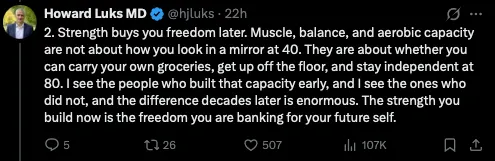
If you’re in life’s middle, right now is the time to build muscle and aerobic capacity.

Right. Now.

Don’t take it from me. Take it from a 63-year-old orthopedic surgeon:

the 76 year old at my planet fitness 05

Highly recommend this whole thread. Lots of wisdom on stress, relationships, and other items that will shape our later years.3

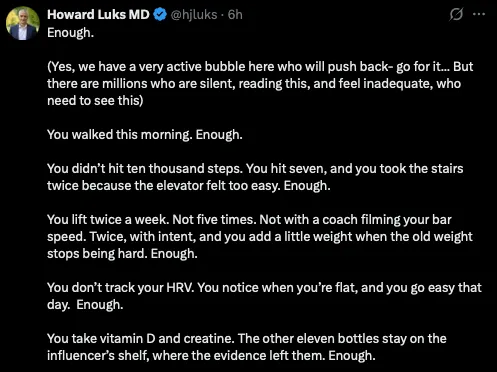
Oh. And I love this reminder, also. Don’t be so hard on yourself:

the 76 year old at my planet fitness 06


Archived from Matt's newsletter.

Footnotes

  1. Unless you’re an airline. Then everyone hates you. Sorry.

  2. Satriani more than did Eddie Van Halen justice playing on Van Hagar songs.

  3. We’re all gonna look like rock stars in our 70s. Just wait.

The 400-Song Playlist and the Three-Day Hangover

the 400 song playlist and the three 01

Old-growth Michigan. The family IT rubric. An Uber driver's ancient MP3 player. The wine-tracking CEO. Start pages, again.


The Map

Michigan was once thick with dense, old-growth forests. White pines, maples, beech, cedar, and many other trees dominated the state.

Then came the logging frenzy of the latter 1800s, when Michigan became America’s prime timber supplier. It was as bad as you imagine. Vast forests, clear cut. The book Wicked Bay City is loaded with sordid tales about lumber workers blowing their earnings and reputations along a stretch of town called Hell’s Half Mile. Quite a read. Quite an era.

But the logger barons didn’t hack through everything. Areas of old-growth remain, like Hartwick Pines State Park.1

(Here’s a list of Michigan’s old growth forests, should you want to visit.)

Michigan’s regrown wild areas are beautiful, no doubt. But the old-growth areas are different. Without a forest reboot, there’s less sameness to the trees’ size and age. That creates a different look, and more resistance to disease and harsh weather.

The variance is a strength.

the 400 song playlist and the three 02


The Machine

I’m the de facto IT director for a few households these days. I set up routers, root out Sonos speaker issues, and tame misbehaving printers, Macs, and iPhones. I try to get wifi signals to bathe even the most remote corners of a home.

Most of the time, the fix takes just a few minutes2. I find the work oddly and intensely satisfying. Bringing just a little more order to the universe. Making someone’s tech experience a little less turbulent.

A rubric that’s emerging for me: the best use of tech requires pruning. Not more. Not “optimization”. Pruning.

Fixing annoying issues. Using tech that supports habits, goals, and interests, and discarding the rest. If we’re mindful, we don’t need most of modern tech offers. Just the trimmed down subset that serves us.


The Music

I was sitting in the back of an Uber on a steamy Tampa afternoon. The driver was a friendly older guy. He had an ancient MP3 player, plugged in the car stereo, that fired off a random assortment of his favorite songs. Chicago followed The Supremes, who followed Ozzy.

I imagined he plugs that thing in every day and happily lets it serve up what it will, as he battles inside the Thunderdome tournament that is Tampa traffic.

I’m a playlist junkie, collecting and pruning songs by all kinds of categories. Genre: Yacht Rock, Country, Classic Rock. Time: 1980s, late 1990s, 1960s. A lot of curation.

My driver was having none of that. He inspired me to create a 400+ song playlist of my own. Essentially, every song I like from my own music collection, spanning decades and genres. Morgan Wallen and Motley Crue. Marvin Gaye and Mumford & Sons.

The variety creates surprise, even pulling from my own music files, the old and new and disparate intertwined, creating their own ecosystem.


The Muscle

There’s an odd fragility to the health and fitness dialogue on X. Especially amongst men who post on the topic. A recent clip made the rounds in which a younger CEO said three glasses of wine cost him three days of productivity.

Seriously?

Then, a study appears saying no amount of alcohol is safe:

Eric Topol@EricTopolThe suppressed report that concluded there is no protective or safe level of alcohol consumption, now published. It was commissioned by US Congress Report jsad.com/doi/10.15288/j… Editorial jsad.com/doi/epdf/10.15… "Despite the study’s adherence to its mandate, its findings were 9:15 AM · Jun 9, 2026 · 65.5K Views


34 Replies · 193 Reposts · 590 LikesBut there’s pushback to the hyper-optimization health movement. We need to live, also. I’m not saying everyone should drink3. I am saying I’ll continue to drink.

What is the real goal of overly stringent health routines? it’s not immortality. It’s the act of chasing purity.

Yes, make mostly good choices. But also, live a little. We don’t last forever, no matter how rigorous a routine Bryan Johnson designs.


The Middle

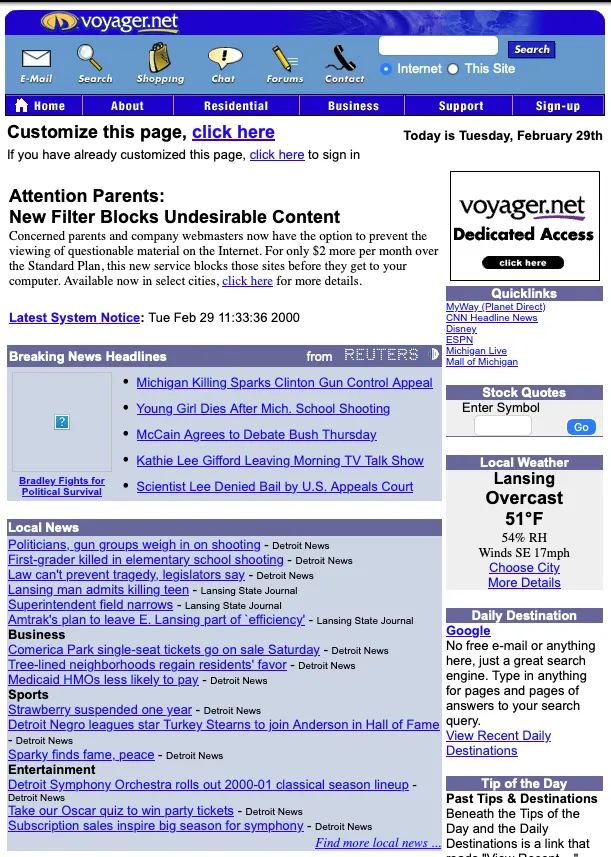
If you are of a certain vintage, you remember the Internet start page. My Yahoo! was ubiquitous, but far from the only choice. MSN. AOL, of course. And you could build a Voyager Start Page, if you were a customer at the Michigan-based ISP I worked at, Voyager.net:

the 400 song playlist and the three 03

Man, that’s a nostalgia hit.4

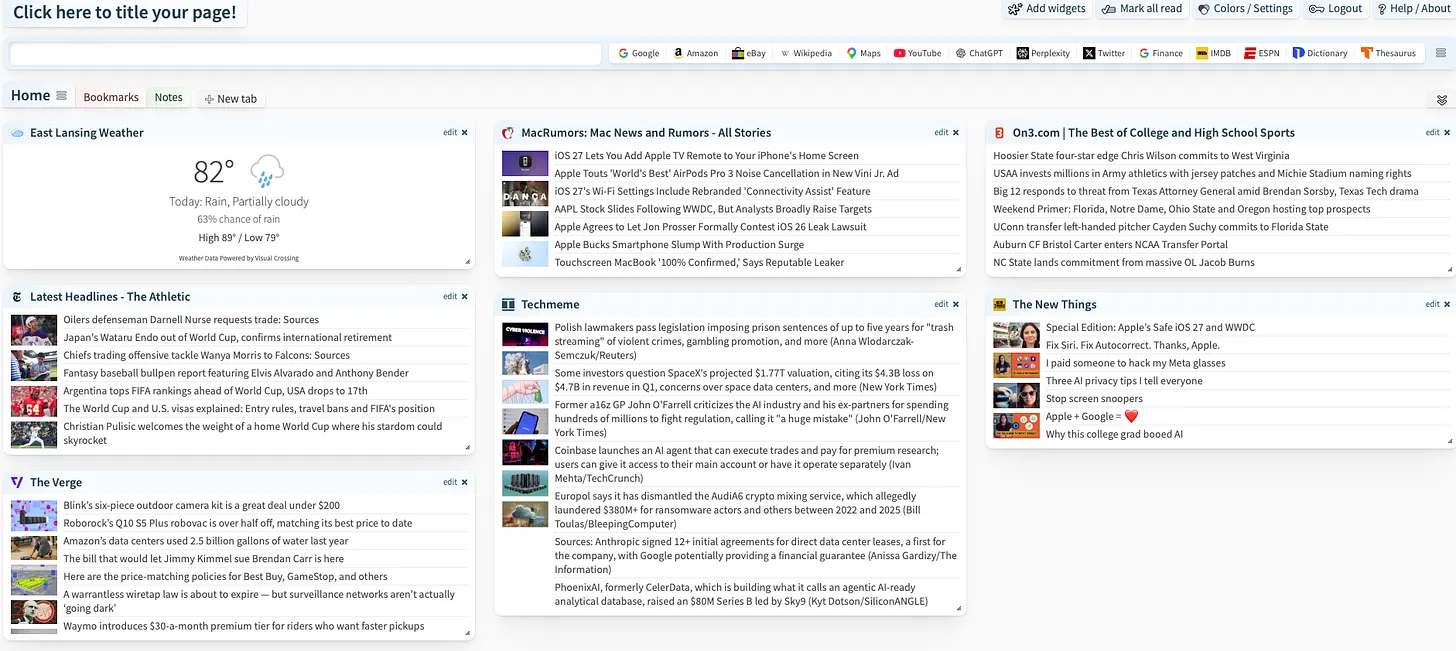
Today, survivors still serve up start pages. Protopage delivers an old-school feel with an easy setup:

the 400 song playlist and the three 04

Yahoo!’s Scout works similarly.

The appeal of the start page in 2026? It’s a page you shape. That you prune. In contrast, on a social media site, an algorithm shapes the experience for you.

But I got to thinking: what could AI bring to a modern start page? Well, if you use ChatGPT or Claude regularly, it knows you a little bit. And it could render a page for you not just based on your preferred news and information sources, but on your intent. What you might want to see on a morning start page could be different than an evening edition.

In my case, I want news about Apple, AI, Michigan, and local sports and weather. But also: ways to synthesize topics into potential projects or newsletter essays. The AI-powered start page shouldn’t just scrape headlines. It should make useful connections between them and the things I want to get done.

Feels like a fun, straightforward project to tinker with. Kind of like we did at Voyager in 2000, but with a modern twist.


Archived from Matt's newsletter.

Footnotes

  1. Took a school field trip there in 1985. Drank enough Mountain Dew to make me sick.

  2. Occasionally, painfully, longer …

  3. Obviously. There are many good reasons peopled abstain.

  4. Also, 51 degrees on a February Leap Year day in Michigan? Miraculous.

17 Years to 1,600 Likes and Other Long Games

17 years to 1600 likes and other 01

Going viral on X, honing intuition, the real problem with Michigan weather, Ambrosia founder crushes it with Keith Urban, the true fitness wins.


The Map

17 years to 1600 likes and other 02

The problem with Michigan weather isn’t the cold.

The problem is summer and fall are unbeatable and unreplicable.

You can move away to a warmer climate. I did.

But it’s not the same.

Not the same cool breeze. Not the same sound the wind makes moving through the trees. Not the same pine smell. The grass feels and smells different.

So you can leave, and miss all that. Or you can stay, and put up with the rest of it. The cold, the clouds, the mud and snow. And find something good in that, too.

I did.


The Machine

The post and photo above were shared on X, and became my most “viral” post of all time1. I’ve been on the platform since 2009, and that’s the first time I’ve had anything go over 1,000 likes.23

I don’t know if I learned anything, other than Michiganders—current residents and ex-pats alike—tend to be parochial, love Michigan, and like that content.

Also, no matter what you post, someone will be mad. 99% of the responses were conversational and positive. But there was also “You’re a glutton for punishment, worst climate in the northern hemisphere!!11!,” “LOL the South smells like pine too,” and various posts deriding the condition of state government.

There’s lots of hand-wringing about the explosion of AI-generated content. To me, a simple antidote seems to just be a real person who posts real stuff.

I am making the bet that real people can still connect with other real people online, weaving through the AI slop like Han Solo through an asteroid field.


The Music

Are we going to talk Yacht Rock in this space every week?4

As if that would be bad.

Keith Urban, country music star and sworn enemy of Nicole Kidman fans, is working on an album of Yacht Rock covers. Here is Ambrosia co-founder and former lead singer David Pack, 73, just crushing “How Much I Feel” on stage with Urban:

17 years to 1600 likes and other 03

No rattle in those pipes. Just as smooth as 1978.


The Muscle

**Fitness marketing is broken.**The industry runs on promises of one-time, large-scale change: dropping large amounts of weight, or hulking out on a muscle-building binge.

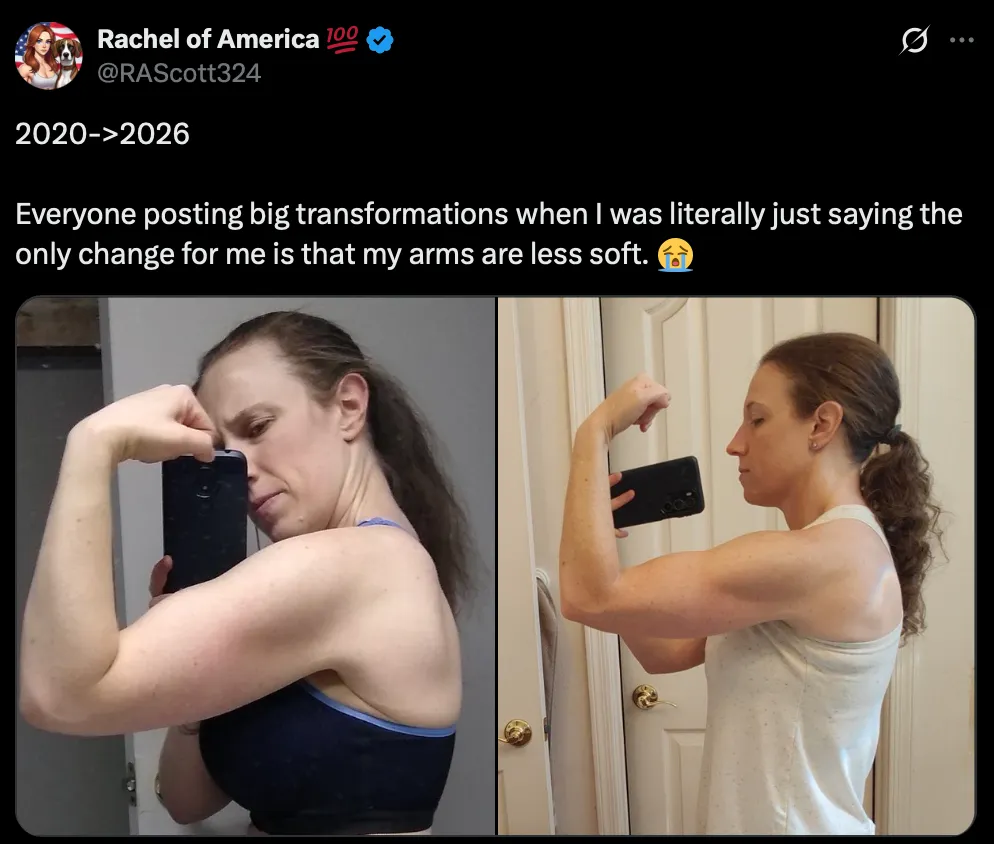
Real fitness is quieter, incremental, and lasts decades. This tweet reminded me of that:

17 years to 1600 likes and other 04

Big-time health changes are great. Don’t get me wrong. But the initial transformation is the first inning of a lifelong game won with incremental progress, just like Rachel’s.


The Middle

Intuition is invaluable, and so difficult to hear.

Entire sectors of the economy are designed to separate you from intuition, to pay attention to them instead of you. And even when you push back against that, you’ve got to dig through a layer of endless mind chatter to get to the heart of it all, that small feeling of knowing.

Intuition ain’t easy.

I can think of major life decisions that I made largely on intuition. But I want more intuition in small decisions that lead to bigger things, also.

This article is worth a read, and the X account is worth a follow if you want to hear your intuition, also:5

17 years to 1600 likes and other 05

Can it be this simple?

17 years to 1600 likes and other 06

I’d like to think so. I’ll ask my gut.


Archived from Matt's newsletter.

Footnotes

  1. My dog has no idea she’s famous.

  2. Follow me for more social media expertise.

  3. Yes, I know real viral flexes have much bigger numbers. But 1600 likes is my biggest flex.

  4. Quite possibly.

  5. Lord, I hope this isn’t an AI account. My intuition says it isn’t …

Your Smart Home Doesn't Have to Be This Dumb

I’m standing next to the bed, in the dark.1

Just need to flip the bedside lamps on, get my workout clothes ready for the morning, and call it a day.

But it seems Siri already went to sleep.

My requests to turn the lamps on go unheeded. I pull my iPhone out of my pocket. Open the Home app and tap the button to turn on the lights.

Nothing.

Just darkness. Sadness. Ineptitude.

Of course, I can just turn the lamp switch on. Except, no. I cannot. The “smart” bulbs override the switch.

I use the iPhone flashlight to find my tank top and shorts and fall into bed, wondering how smart homes can make life seem so dumb.

And yet, when the tech works, it can feel like magic. Like when the garage door yawns awake as you pull in the driveway. Or a warm and low light coming on when you step into the bathroom at night.

Good smart home technology removes friction. The house adjusts to you.

That “good” version—simple tech and automations that just work—2might be closer than many realize. AI will make products and automations easier to set up and use, and Apple, with new CEO John Ternus taking over in September, is poised to strengthen the Apple Home platform and products.

Google, Apple, and Amazon are all want to be your smart home platform. I’m placing my bet with Apple.

If you already have iPhones, Macs, and an Apple TV, you’ll find that Apple Home controls and alerts work very nicely with your existing devices. You have the control and communication hardware, and are comfortable using it.

Apple’s platform runs locally through an Apple TV or HomePod hub. That’s fewer trips to the cloud, one less point of failure, and a more secure and private experience, by design. And Apple Home is designed on the open communication standard Thread and the instruction layer Matter. That means setup and operations are simpler. Less fiddling, more “it just works.”3

Finally, once Apple ships something, they tend to support it for a long time. Google, not so much. Google is notorious for pulling the plug on services--even popular ones.

Of course, there are downsides to Apple Home. That commitment to privacy means additional hoops and expense for third party lights, locks, cameras, and other hardware to work with Apple Home, so there are fewer options. Apple is rarely first to innovate in any space, so Google and Amazon get the bleeding edge stuff first.

And Siri, well, Siri is way behind. But later this year, a new Siri is coming that will be powered by other leading AI platforms. This should help Home catch up.

I’ll take those tradeoffs.

Apple’s World Wide Developer Conference is next week, and we should see announcements about Apple Home and possibly some new products, like an updated HomePod Mini.4

I’m optimistic about the smart home’s future, and Apple will have the best mix of privacy and simplicity to help homeowners get comfortable with the space.

Pretty soon, we may not even need a flashlight to find our workout gear.


Archived from Matt's newsletter.

Footnotes

  1. Not in a hockey mask with a butcher knife or anything. Just trying not to bang my shin on the bed frame.

  2. Em dashes! No, AI didn’t write this. I like em dashes.

  3. The lights actually come on.

  4. Underrated product in my opinion. But we may not see the new speaker until iOS 27 launches in September.