The Case for a Personal Website in 2026
My daughter is hooked on this coffee place called Seven Brew.
I believe the establishment is so named because seven is the minimum amount of ingredients and flavors you must add to your drink order.1 Often, I have learned, a Seven Brew drink doesn’t even contain coffee. I think that’s because there isn’t room left in the cup after all the other stuff is added.
The most popular drink combos shift all the time, powered by TikTok trends.
A personal website that hosts your writing is the black coffee of the internet. Timeless. Useful. Never goes out of style, even as trends whirl and shift around it.
I didn’t always believe this.
In 2024, it seemed personal websites had run their course. Substack seemed a haven for writers. I went all in, shutting down my standalone site.
My blog-building began with Microsoft Front Page in the early aughts, before moving to Typepad2 and then Squarespace.
Here are a couple of posts from 2009,3 just to keep things honest:
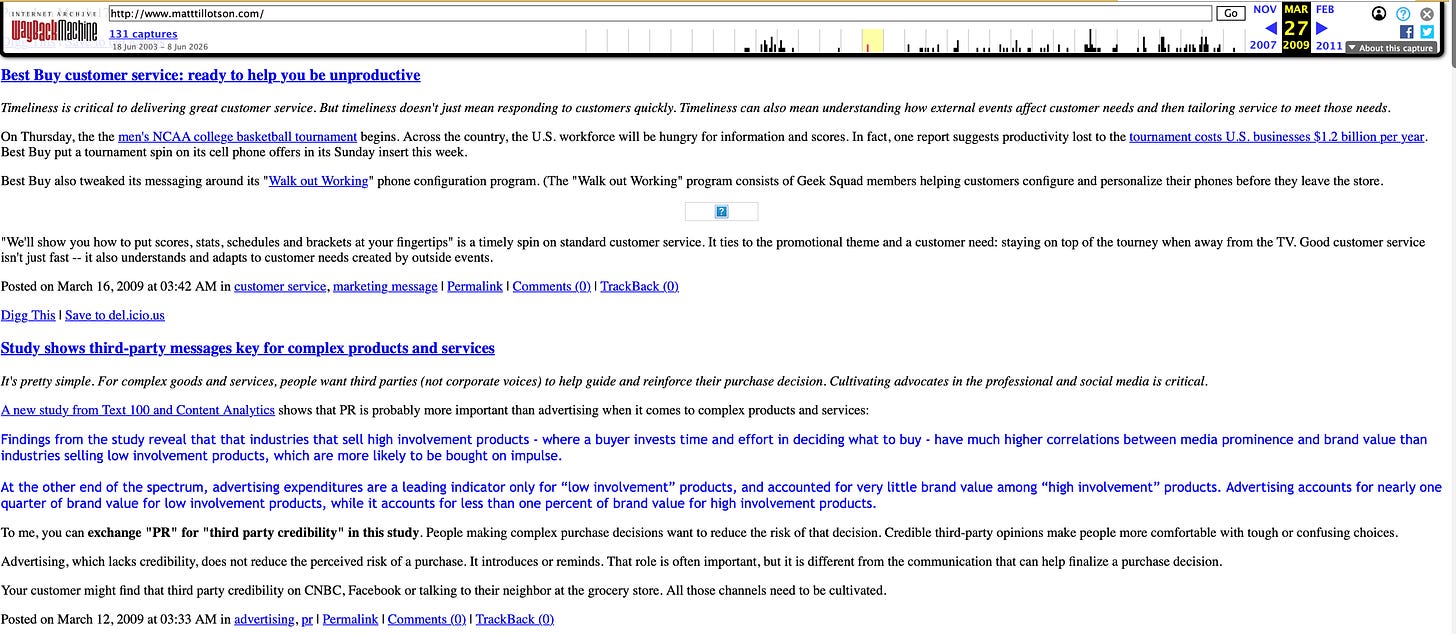
Pulling the plug on my own website was a mistake.
I owe much to Michael Dean, who relaunched his own personal site, and wrote this post about how he did it. That nudged me to rebuild my own.4
The Free Traffic Engine Sputters
I don’t want to discourage anyone, but if you launch a personal site to build attention and visitor traffic, you’re facing Cat 5 headwinds.
One study suggests that as of early 2026, 68% of Google searches end without a click to a link, with users opting to read Google’s AI-generated content instead.5
The second challenge is AI chatbots. As more people turn to AI for answers, only 5.2% of information-seeking sessions result in a click.
Traffic to the open internet is drying up.6
Now that you are sufficiently disheartened, let me pivot: there are good reasons to have a personal website.
Why bother with a personal website in 2026?
My reasons will be different than yours. As it says in the top left column of my site:
A site to ingrain and invigorate the habits of reading and writing.
A couple of things are true for me:
-
When I exercise every day, I feel better and work better.
-
When I read from a book and write every day, I think more deeply and am more creative.
I’m on top of the first practice. The second had become inconsistent. My creative energy isn’t served by sporadic effort. It requires swinging the hammer daily.
And my site serves as the fulcrum for that daily rhythm. It’s a catalog of the books I read, the passages I highlight, and the writing that comes from that consistent reading habit.
One page lists most of the books I’ve read in Kindle since 2010—around 450 or so. All the book passages I’ve highlighted—more than 26,000 of them—have been sorted and imported onto a page for each book.7 Any reviews or related entries I’ve written about a book also appear on that corresponding page. My new writing is shared and archived, blog style, on the front page. The site also has a bunch of my archived posts from my old Squarespace site.
It’s fun to integrate some of those Kindle highlights into my writing. Those 26,000 passages represent the words that stuck with or surprised me over 15 years of reading.
The site leans into my personal thinking trail and my perspective. The stuff that, you know, makes me a person and not software.
Anything I write now goes on my personal site first. That includes longer essays, like this one, and shorter notes. Some of that writing will also be shared and distributed here. But my site is the central repository for all my writing.
So, to sum it up. My personal website:
-
Serves as a living catalog of the books I read, the passages I highlight, and my own ideas and writing.8It helps crystallize my own perspective.
-
Serves as an accountability engine to sustain my habits of reading and writing.
Could I just post everything to social media? Of course. But think of it like this:
There is value to sharing your writing on social sites. I’m not arguing you shouldn’t. But the amorphous social media landscape never holds still. Look how often the X algorithm changes.9 Facebook might become another TikTok. The energy is always on the move.
With your work anchored on your own site, you’re can follow that energy to other channels.
Social media is gambling on a football game. The value is here and gone. A personal website is investing in an index fund for 20 years. Value compounds.
An Antidote to AI Doomerism
We are subjected to an endless tsunami of negative content around AI: that it’s replacing our creativity, destroying our ability to concentrate, and obliterating our ability to express ourselves.
This project does the opposite. AI did all the coding and formatting dirty work so I can read and write. I feel the rust coming off, because I don’t have to worry about the technical machinery.
In 2026, a personal website isn’t primarily about amassing traffic. It’s about what you want to make, organize, and preserve that would otherwise be lost.
My site is the black coffee that jolts me into reading and writing every day. I’ll drink to that.
Footnotes
-
What is cold foam? Is there hot foam? ↩
-
Typepad shut down in August of 2025. What a run. ↩
-
I didn’t say they were good posts. ↩
-
Another day, I’ll share a post about the base technologies, the build, and the ongoing process of publishing my site. Today is just about the why. ↩
-
Nilay Patel calls this “Google Zero.” ↩
-
Someone is working on this, right? How about a search engine that indexes sites, and provides links to them based on user queries. Wild idea, I know. ↩
-
In at least one alternate universe, I work in a library. I’m sure of it. ↩
-
Hourly. ↩